NASA’s Goddard Space Flight Center

Directions Website

NASA’s Goddard Space Flight Center Your friendly neighborhood space flight center. 👩‍🔬🚀

Welcome to the largest community of NASA welcomes your comments. No personal attacks. No profanity. No spam.

(275)

NASA's Goddard Space Flight Center is home to the nation's largest organization of combined scientists, engineers and technologists. We build spacecraft and instruments, and invent new technology to study the Earth, the sun, our solar system, and the universe.

To encourage free-flowing discussion while maintaining the decorum appropriate to a taxpayer-funded organization, we will moderate comments using these guidelines:

Stay on topic. Other readers expect the comments about a post to deal with the topic at hand. If your comment is not relevant to the post, please post it as a Discussion topic elsewhere.

Criticism of decision-making and operational management, including the names of the individuals involved, is legitimate. Criticism on a purely personal level is not.

No sexually explicit or discriminatory material.

Comments about politics and politicians must, like everything else, be on-topic and free from personal attacks."

Direct messages will usually be replied to as soon as we. We'll do our best to get back to you if you have a question.

11/12/2026

This year’s Antarctic ozone hole ranks 7th for annual maximum extent

Ozone in the stratosphere acts as Earth’s sunscreen, shielding life from harmful solar radiation. The Antarctic ozone hole reached its maximum extent — 10.5 million square miles — on September 18. This year’s ozone hole was larger than those seen in the past decade, due to a powerful polar vortex.

But the protective layer is still trending toward recovery. The ozone hole could have been 1 to 2 million square miles larger if ozone-depleting substances were as prevalent in the atmosphere today as they were two decades ago.
11/09/2026

Lucy: 1
Odysseus: 0

The Lucy spacecraft has officially reached the Jupiter Trojan asteroid region, just 5 years after launch — half the time it took Odysseus to get home from his voyage to the Trojans.

The Jupiter Trojan asteroids are remnants of our early solar system, trapped in the same orbit as — but not close to — Jupiter. By studying the Trojans up close, we can learn more about how our solar system’s planets formed 4.5 billion years ago.

Curiosity didn’t kill the cat, it helped NASA capture it 🐱NASA's Hubble Space Telescope and NASA's James Webb Space Tele...
11/06/2026

Curiosity didn’t kill the cat, it helped NASA capture it 🐱

NASA's Hubble Space Telescope and NASA's James Webb Space Telescope peeked at the Cat’s Head Nebula. Despite its demure and fluffy appearance, the star-forming region was shaped by shockwaves from nearby massive stars in the Carina Nebula.

Hubble imaged the feline’s glowing red eye, which scientists think is a young star obscured by dust. Webb’s near-infrared camera captured a different view by peering through the dust, spotting stars otherwise shrouded by dust. In the mid-infrared, the intricate structure of the cat’s body is noticeable because starlight causes the dust to heat up and “glow.”

WAKE ME UP when you spot the strangest galaxy (galaxies?) in this image 🎸Hidden among the many galaxies captured in this...
11/05/2026

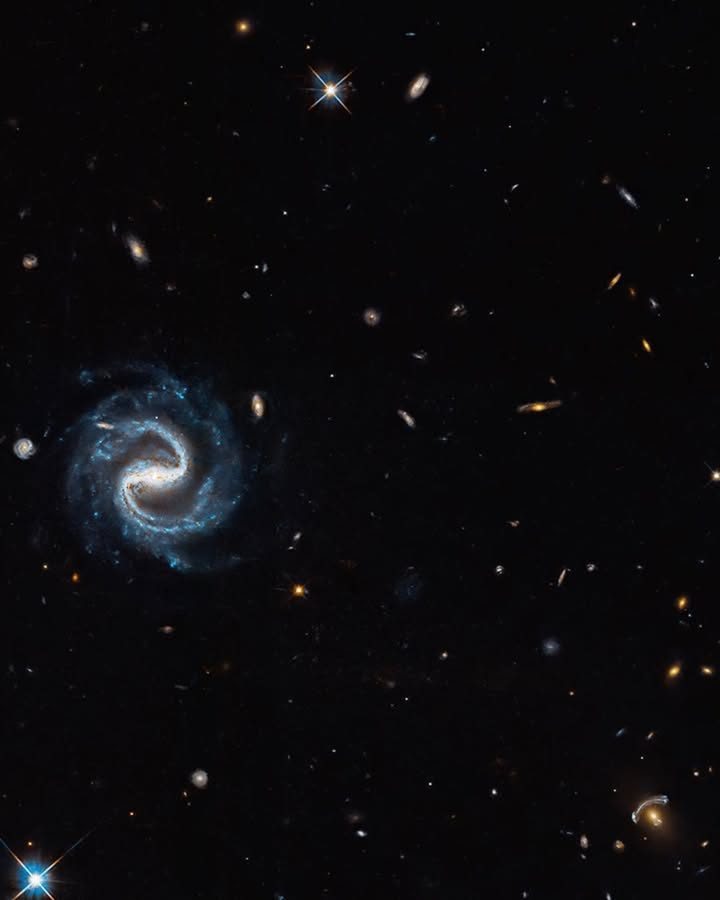
WAKE ME UP when you spot the strangest galaxy (galaxies?) in this image 🎸

Hidden among the many galaxies captured in this image by NASA's Hubble Space Telescope lies an oddity in the bottom right corner. A massive foreground galaxy is acting as a gravitational lens, magnifying and bending the light from a more distant galaxy behind it.

The background galaxy appears as two arcs: a small, distorted arc in the bottom right and a prominent arc in the top left. Multiple arcs appear when the galaxies align with Earth in just the right way. This specific configuration is called an arc-counterarc pair. Check out the duo up close in the second image.

Observations like these help pave the way for the Nancy Grace Roman Space Telescope. With its view 100 times wider than Hubble, Roman will spot thousands of lensed galaxies, helping astronomers map dark matter and better understand the invisible mass found in galaxies.

Hubble observations are already helping create a computer model to analyze distortions from dark matter in future Roman images. Once Roman begins finding lenses by the thousands, Hubble plans to follow up on the most intriguing finds!

11/02/2026

Reaching an “island of stability” 😌 (gravitational stability, that is)

NASA’s Lucy is the first spacecraft to visit a group of primitive solar system bodies known as the Jupiter Trojan asteroids. These asteroids share Jupiter’s orbit, guided by the combined gravitational pull of the Sun and the gas giant planet.

The Trojan asteroids serve as time capsules from the birth of our solar system over four billion years ago. By studying them up close, Lucy will uncover clues about the environments in which all of the planets, including Earth, formed and developed.

As Lucy cruises deeper into space, it has adapted to the gradually cooling temperature and dimming light. Lucy was designed for these conditions, and the spacecraft and instruments are working as expected.

Pack your bags, we're heading to Titan! Add your name to fly along with Dragonfly, the rotorcraft we're sending to Satur...
11/02/2026

Pack your bags, we're heading to Titan!

Add your name to fly along with Dragonfly, the rotorcraft we're sending to Saturn's largest moon. Download your boarding pass now!
go.nasa.gov/dragonfly-names

10/30/2026

🎃 What's that lurking just beyond the light of our own Sun? Something haunts the universe.

Gather 'round the campfire for a Halloween tale of terror: a planet that never existed at all.

10/29/2026

🪐 Nearly a billion miles away, an extraordinary destination awaits. NASA’s Dragonfly mission will journey across the solar system to Saturn’s largest moon Titan, and your name can come along!

Add your name to the passenger list and receive a personalized boarding pass for the adventure ahead. Become a Dragonflyer today: go.nasa.gov/dragonfly-names

10/29/2026

Higher waters, warmer waters, bluer waters

El Niño is a natural weather pattern that occurs roughly every 2-7 years. This year’s is on track to be the strongest on record. While El Niño occurs in the Pacific Ocean, its effects can be felt all around the world. NASA satellites like PACE and Sentinel-6 are equipped to measure some of the key features of the phenomenon.

As months pass in 2026, notice the large swath of higher-than-normal waters and warmer-than-normal waters, appearing red, growing along the equator. Phytoplankton are also feeling the heat and are changing the color of the ocean — bluer, in areas that are typically greener from phytoplankton abundance.

All treats, no tricks! Grab yourself something sweet: a pixel of the Nancy Grace Roman Space Telescope's first images. A...
10/29/2026

All treats, no tricks!

Grab yourself something sweet: a pixel of the Nancy Grace Roman Space Telescope's first images. Adopt your own and become part of our bigger picture of the universe, no costume needed!
go.nasa.gov/AdoptAPixel

Address

NASA Goddard Space Flight Center
Greenbelt, MD
20771

Alerts

Be the first to know and let us send you an email when NASA’s Goddard Space Flight Center posts news and promotions. Your email address will not be used for any other purpose, and you can unsubscribe at any time.

Shortcuts

Share

Nearby engineering companies









